
When the State prescribes decrees to a dying patient (S.D. No. 014-2026-SA)
Faced with 94.5% of medical posts dismantled and a system on the verge of structural collapse, the Executive inaugurates a ninety-day bureaucratic vigil to redraw ministerial hierarchies without spending a single sun from the Public Treasury.
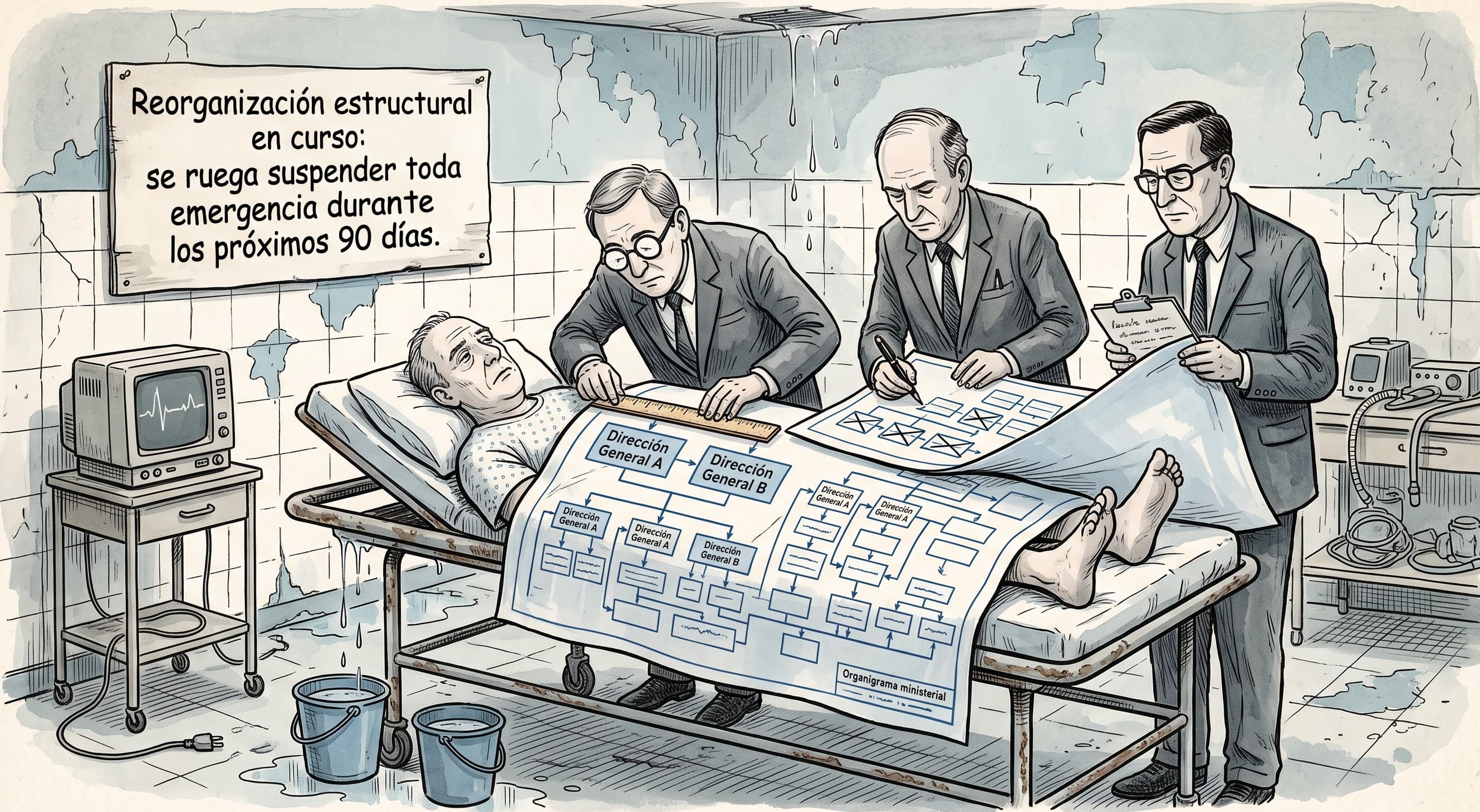
There is an almost liturgical reflex in the Peruvian public administration, a sort of conditioned reflex that replaces emergency surgery with the secretarial procedure. Whenever the state apparatus threatens to break its material seams, the political power does not come with beds, drugs or medical crews; it goes, with invariable notarial solemnity, to the pages of the official newspaper El Peruano to found a commission, initiate an inventory or draw up a new organization chart. Supreme Decree No. 014-2026-SA, promulgated in the last hours and endorsed by the Minister of Health, Luis Williams Dyer Fernández, under the presidency of Keiko Sofía Fujimori Higuchi, is a monument to this doctrinal drive. The regulation declares the Ministry of Health in a state of reorganization for a period of ninety calendar days. The overriding goal? Carry out a comprehensive review of its units to correct duplications, overlaps and gaps, adapting the structure to the goals of the National Multisectoral Health Policy to 2030 Peru, Healthy Country. The legal rhetoric is impeccable, almost surgical. The Framework Law for the Modernization of State Management is invoked, the Organic Law of the Executive Branch is cited and the principle of citizen orientation is appealed to. However, behind the aseptic prose of the recitals hides a painful contradiction: the State intends to exorcise a clinical catastrophe with administrative geometry tools. The Fiction Timeline: Four Critical Knots
✦ While technicians in the sector plan to write diagnostic reports, the territorial reality documented by Susalud indicates that 94.5% of primary care facilities operate with inadequate installed capacity, dilapidated infrastructure and outdated or nonexistent equipment. The country's first sanitary containment ring is an empty shell. ✦ Article 3 of the supreme decree prescribes with astonishing lightness that the reorganization process will be executed exclusively from the institutional budget of MINSA itself, 'without demanding additional resources from the Public Treasury'. It seeks to transfigure a historically defunded sector through a redistribution of desks, like those who intend to put out a forest fire by changing the order of the empty fire extinguishers. ✦ The Peruvian health collapse does not arise from functional duplication between deputy ministries, but from the hemorrhage of human capital. In departments such as Junín, reports from the Comptroller General's Office reveal a critical defection of medical professionals and an average that exceeds 500 inhabitants per physician, forcing patients to circumvent posts without doctors and hospitals where the availability of beds decreases over the years. ✦ The rule gives the Office of Organization and Modernization sixty days to diagnose what a dozen health crises have already shouted: that the system is unresponsive because it lacks oxygen, critical supplies, and basic logistics. Lessons from global collapses - from saturation in Lombardy to the tragic second wave in India - showed that viruses and bacteria are not waiting for a new operations manual. The gap between the ministerial palace on Salaverry Avenue and the rural poles is not a management divergence; it is an existential distance. While the bureaucracy builds consensus with senior management bodies to adjust its hierarchical tree, citizens continue to experience public health as a survival lottery.